A Local's Guide to Street Food Etiquette in Bangkok
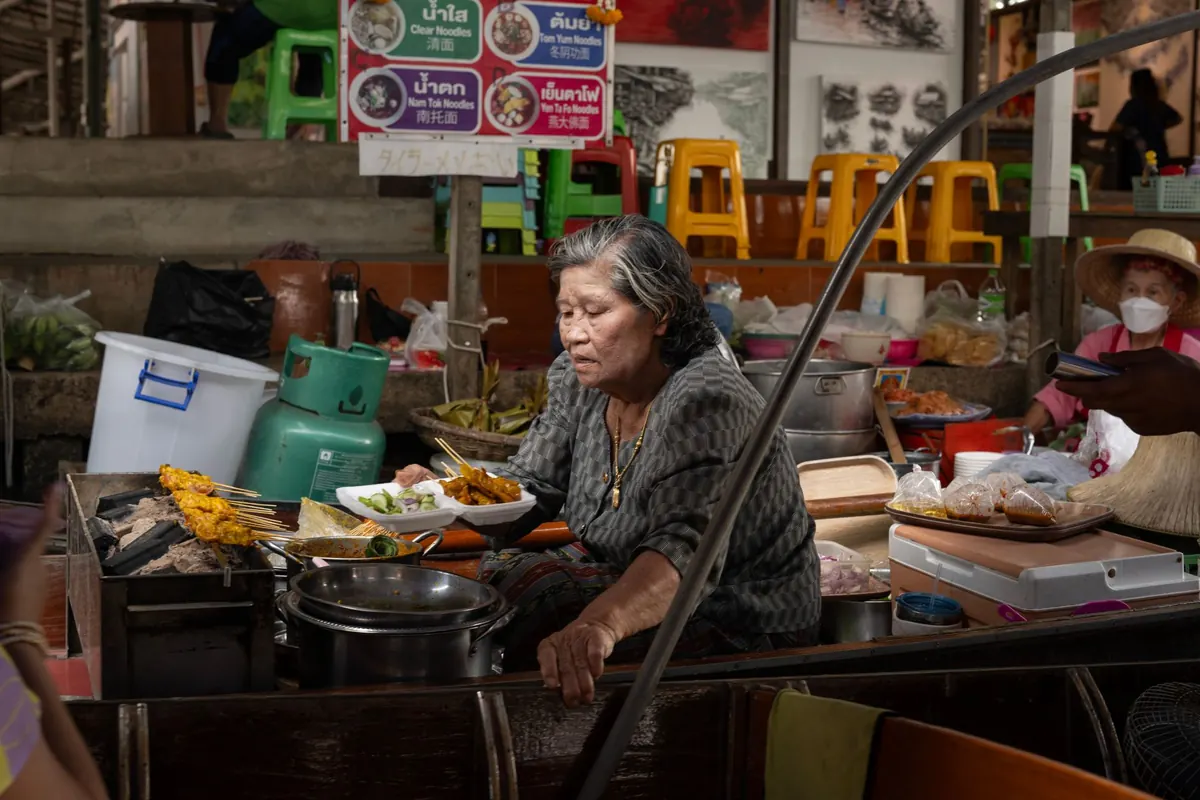
At seven in the morning someone on Soi Pradit is already ladling broth over rice noodles. By midnight in Yaowarat, the same ritual is running under neon: grilled squid, woks of oyster omelette, a woman squeezing limes into som tam with the speed of a card sharp. Bangkok feeds itself on the pavement, at tables the width of a laptop, for less than the price of a coffee back home.
None of it comes with instructions. Thais learn the system by growing up in it, and visitors usually pick it up by watching, guessing, and occasionally getting a bowl far spicier than they intended. Here is what you actually need to know before you pull up a plastic stool.
Read the stall before you commit
Turnover is your best guide. A stall with a queue of office workers at noon, or a crowd of motorbike drivers at eleven at night, is cooking constantly, which means nothing sits around. If a place is empty at peak mealtime on a busy soi, there is usually a reason.
Look at what's happening on the heat. A wok going hard, a grill with skewers coming off it hot, a pot of broth being replenished — that's the pattern you want. Rice-and-curry shops (khao kaeng), where you point at trays, are perfectly good when the trays are steaming and the queue keeps moving. Be pickier about lukewarm piles of pre-cooked food sitting uncovered in the afternoon sun, especially seafood.
Menus are usually short for a reason. A stall that does one noodle soup brilliantly will beat the cart trying to sell forty things. And if you see a yellow flag with red characters — a jay flag — the stall is cooking vegetarian or vegan food, often strictly so.
Ordering without speaking Thai
Point at what you want, hold up the number of fingers, and smile. Pointing with your whole hand or a small chin-lift is politer than a single index finger, though nobody will scold you for it. If you can't see a menu, look at what the person next to you is eating and point at that instead. It works.
A handful of phrases cover most situations:
- ao an nii — I'll have this one (while pointing)
- mai phet — not spicy
- phet nit noi — a little spicy
- mai sai — don't add (works for sugar, coriander, chilli)
- mai sai nam khaeng — no ice, please
- kin jay — I eat vegan
- khop khun khrap (man) / khop khun kha (woman) — thank you
Two things surprise first-timers. First, heat levels are wildly inconsistent between stalls, so the safest order is mai phet and then build the heat yourself from the condiments on the table. Second, at a noodle stall you're ordering one bowl for one person, and boat noodles are deliberately small — locals order two or three. Dishes also arrive as they're ready, not all at once, so don't wait for everyone's food before starting.
Where to sit, and the table that isn't yours
At a pavement stall, order first, then take a stool. If there's a queue, wait to be waved to a seat. Sharing a table with strangers is completely normal; a nod is enough.
The rule that trips up visitors is the market table. At places like Yaowarat or a weekend market, the tables and stools in the middle of the lane often belong to the drinks vendor, not to the food stalls around them. You buy a bottle of water or a beer, and the seat is yours. Sitting at someone's table eating another stall's food without buying anything is the one move that will get you a polite but firm look.
Keep your bag off the table, and keep your feet on the ground — never on the table, and ideally not pointed at anyone. Tissues and condiments stay put for the next customer. Take only what you need.
Paying: cash, small notes, and no tipping
Assume cash. Coins and small notes are king — breaking a large note at a street stall is awkward for everyone, so change a bigger bill at a convenience store or mall first. Some stalls display a QR code for mobile payment, but unless you have a Thai bank account, don't count on it.
At some stalls you pay when you order; at others you pay at the end. If you can't tell, hold up your cash and let them tell you. Many busy noodle shops leave a small tray or cash box on the counter where you drop your money; if that's the setup, be honest about making your own change.
Tipping isn't expected. Leaving the coins from your change is generous enough. If you've ordered from several stalls at one market table, expect several separate bills.
How to eat it
Thai food comes with a spoon and a fork. The spoon is your eating utensil — hold it in your dominant hand — and the fork stays in the other to push food onto the spoon. Chopsticks appear for noodle soups and Chinese-style dishes. Some shops bring a small bowl of hot water so you can rinse your cutlery; it's a courtesy, not a judgement.
The condiment caddy is the heart of the table: chilli powder, sliced chillies in fish sauce, chillies in vinegar, and sugar. Add a spoonful at a time, taste, repeat. Sugar isn't just for dessert — a pinch in a noodle soup balances the salt. And slurping your noodles is fine. What you shouldn't do is stand your chopsticks upright in a bowl of rice.
Eating safely without being paranoid
Bangkok's street food is not inherently risky; careless storage is. Stick to these habits and you'll be fine:
- Eat where food is cooked to order and turnover is high.
- Choose grilled skewers straight off the grill, not those resting in a pile.
- Drink bottled or sealed water. Tap water isn't for drinking.
- Prefer fruit peeled in front of you over fruit pre-cut and sitting out.
- Carry hand sanitiser and tissues; not every stall has a sink.
- Ice in Bangkok is usually commercially produced and fine, but if you'd rather not, ask for none.
Watch the salt, sugar and chilli if you're not used to them — Thai drinks are famously sweet
Photo: Miguel Cuenca / Pexels